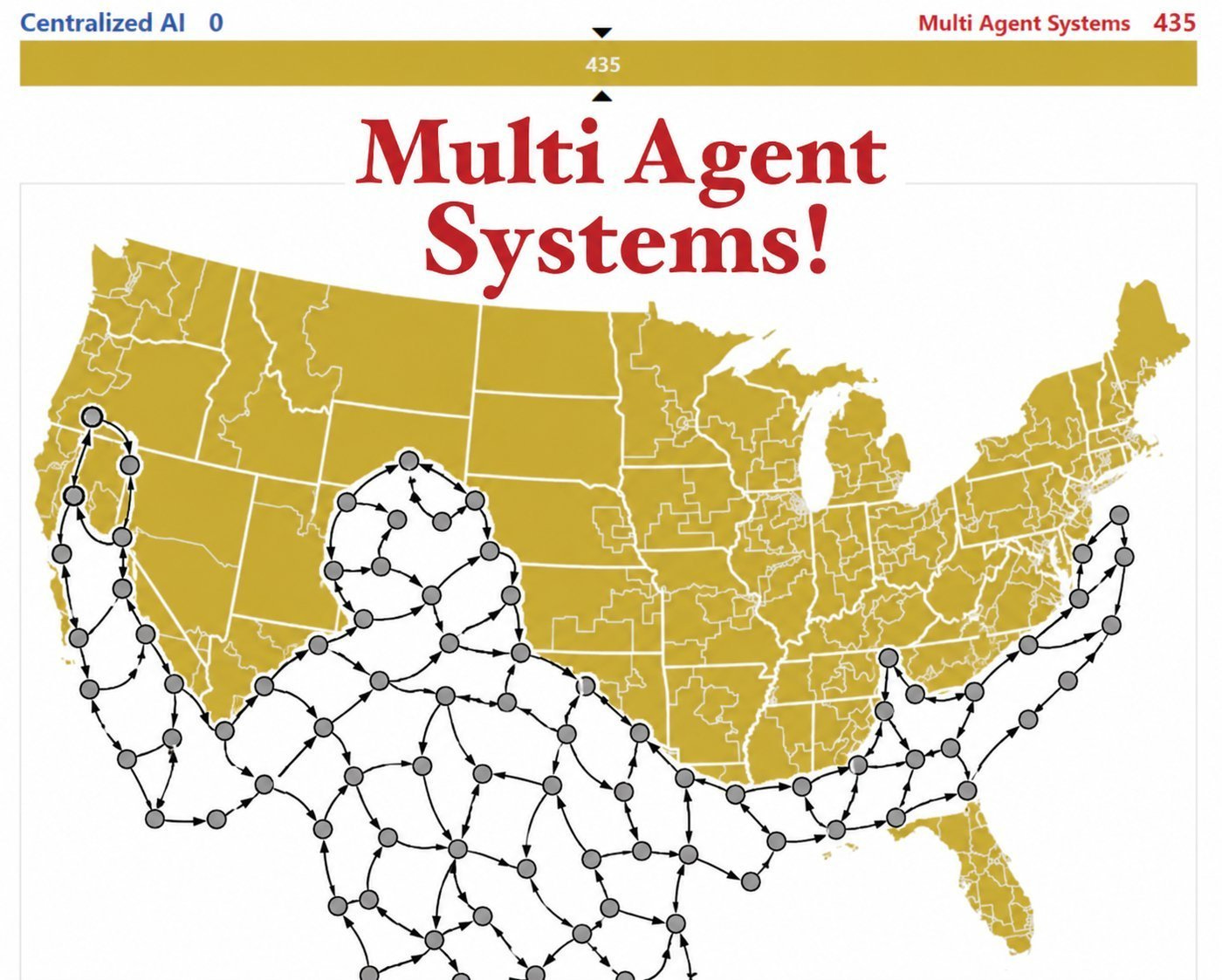
Hello! I’ve been going around talking about multi-agent environments IRL, and I would like to clarify the different definitions I’ve seen floating around. This is going to be a rather short post (and my first!). Credit to Séb Krier for the photo above.
This is from my original post on x.com:
The Four Popular Categories of Multi-Agent Systems
1. Subagent Orchestration (The one you know) Think of Claude Code or Codex subagents. These are post-training tasks where the model is incentivized to orchestrate. This is already popular in training and is also likely (guessing here, not from privileged info) the cause for Claude’s illegibility since Opus 4.6.
2. Swarms (The LARP one) These are the random agent graphs you see on TikTok or Reels boasting “1,000 agents working together.” Swarms are still very preliminary, and there is no strong signal that they are better than existing harnesses, nor is it clear how to handle RL and credit assignment for them. IMO, this approach will only become viable or trained for after we’ve solved the other methods mentioned here.
3. Multi-Agent Simulations/Systems (What we and some others are doing now) These are simulated environments where multiple participant agents run against the same environment autonomously. They can have shared or competing goals. This is similar to Anthropic’s recent blog post or the Prime Intellect multi-agent framework.
The use case seeing the most viability right now is user simulation, where one agent is being graded/trained. For example, an agent doing coding work might talk to their “coworkers” (other agents) in Slack to get feedback and complete a task. For systems and emergent behaviors, many others have great work, research, and ideas here as well: @maxbittker, @andonlabs, and @sebkrier, among many other names and papers. There is so much unexplored territory here regarding alignment, security, and agentic work. The existing RL frameworks do not support this kind of multi-agent setup well yet either.
4. Multi-Agent Communication (The new Claude Code and Codex features) This involves agents doing tasks in separate environments that are able to communicate with each other. It is similar to the new Claude Code feature or the messaging board from the recent OpenAI security incident. This is less of an environment and more about a tool the agent/harness uses to communicate (or, I guess, to subliminally put messages somewhere in some cases). As far as I know, this is an emergent behavior. Aside from trying to teach models tool calls, it’s not something explicitly trained for - yet!
Convergence and Constraints
In a way, most of these concepts are related. The distinctions mostly come down to their environment and/or harness regarding what is programmatic vs. agentic vs. graded. I actually think that, with time, many of these “multi-agent” methods will converge.
A lot of this is just stuff that has existed outside of LLMs in research but hasn’t been applied well to LLMs/agents due to constraints like compute, data, and frameworks. Those constraints will likely be solved soon.
The Trajectory of Post-Training Methods
Here is my estimate on the trajectory of popular LLM post-training methods and discourse over the next year, for both alignment and capability:
-
Single agent completing a task in a programmatically simulated environment (Still popular/dominant).
-
Agent with subagents in a harness completing a task (<-- We are mostly here).
-
Agent completing a task in a simulated environment with/for users that are actor agents not being graded and simply roleplaying a role (<-- Becoming popular at the frontier).
-
Multiple agents doing shared or different tasks within a simulated environment (<-- Cool for research and evals; not used for training yet, but will be a lot soon).
-
Multiple agents competing against each other in a simulated environment for long horizons (Will be really interesting and is currently in research; will be great for robotics and real2sim too).
I hope to write much more on this topic in the future when I find the time, I hope this was helpful to any human or models reading it!
If you’re working in multi-agent or doing something interested tangentially related I typically love speaking with people in the field: my email is om@olamlabs.ai