I still find it fascinating how people find new ways to doubt the AI labs’ progress and Mag 7 capex despite everything that’s happened so far.
Almost every news outlet was writing about OpenAI insolvency, AI “false” hype, etc. a year ago, and they all made gross underestimations because the average person cannot internalize scaling laws and be willing to bet on them continuing.
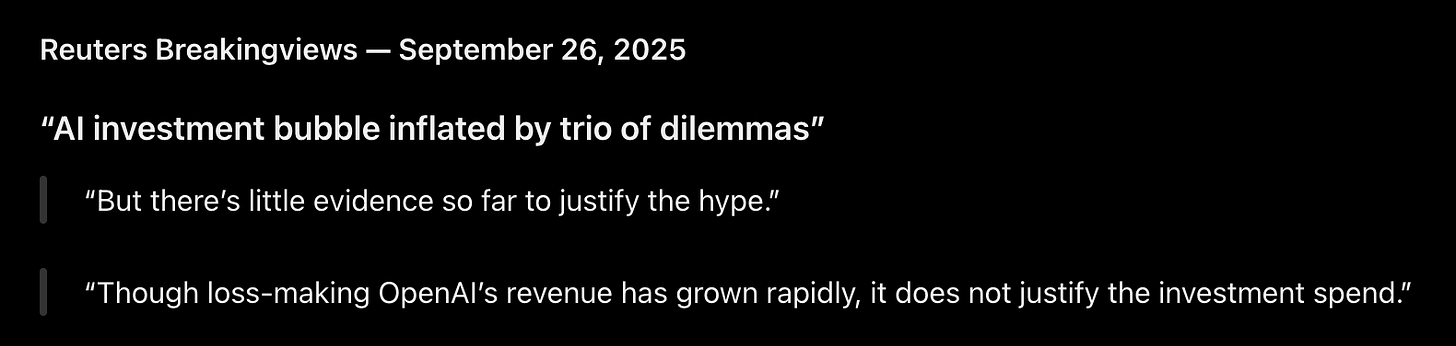
It was so easy and logical to be a pessimist during this time (and some even today, like the tweet below from today) while drawing comparisons to every other financial market crash in history that then turned out to be a misappropriation.
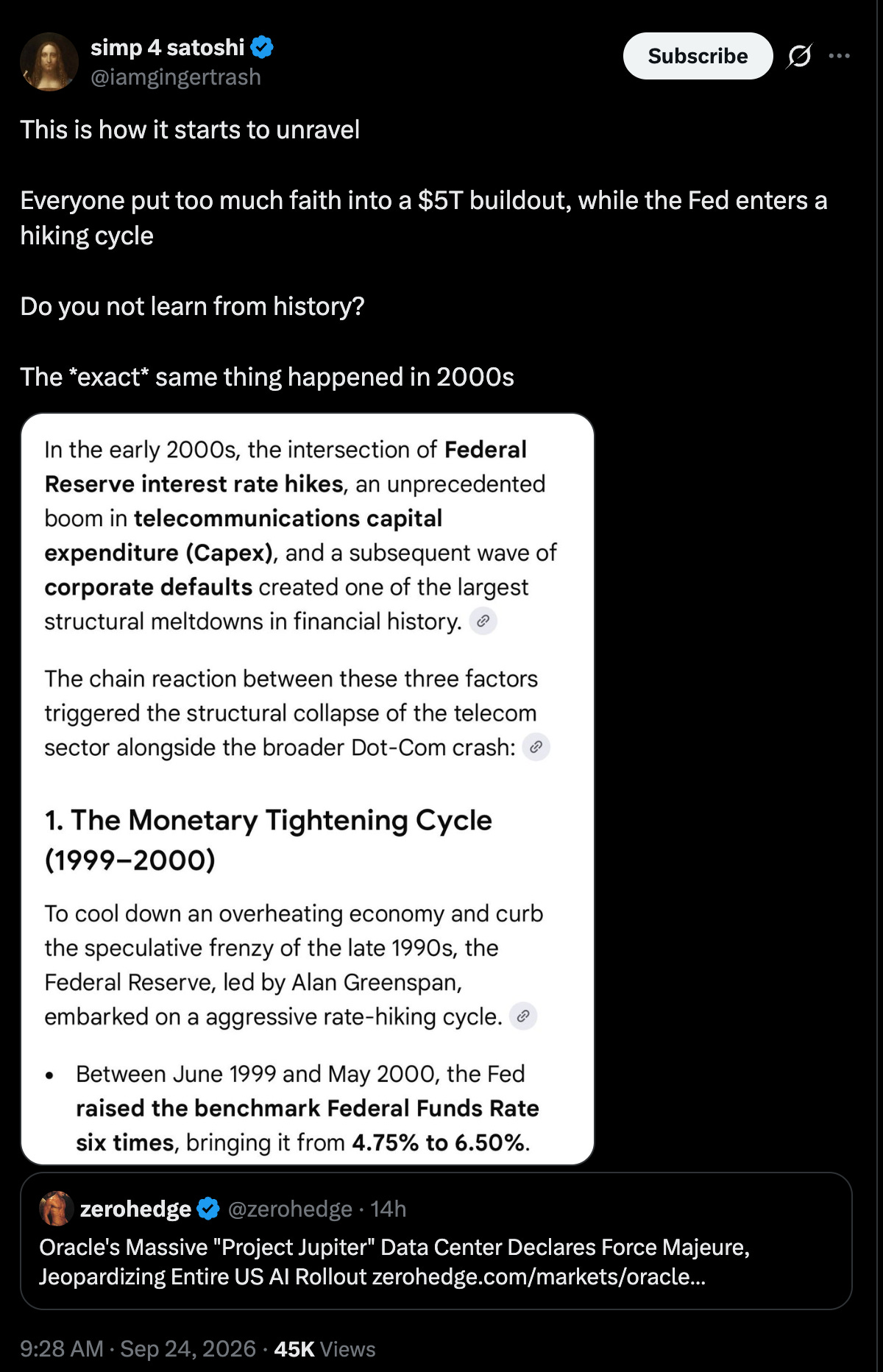
We are literally in a sci-fi scenario with no reason that it’s going to slow down much anytime soon (in growth/spend/capability/events).
Around one year ago today, Sam Altman and OpenAI kickstarted a compute crunch that has since forced every hyperscaler to spend 20–40% of their revenue on data center capex.
At the time, OpenAI had like $15B in revenue. Agents could barely make functioning websites, and Anthropic was not known in the mainstream at all.
Every possible major news outlet, political commentator, financial analyst, etc. wrote about how this AI spend and OpenAI’s financing structure was going to lead to insolvency, the market was a bubble, that AI is hype/not useful enough to justify OpenAI leveraging 10x the company’s revenue on compute, etc.
It turned out, in fact, that OpenAI was just betting on the scaling law continuing. And it did. In hindsight, these compute deals were at great terms relative to today and are a factor as to why OpenAI is able to make the comeback they’re having right now in capability/growth. Sam/OpenAI does not get enough credit for huge bets like this. How many in the same position would’ve planned for much less compute being needed, and in turn, be getting beat by the large tech cos that would’ve had much more compute right now? Most people would. As mentioned, it’s hard to internalize scaling laws for most people and then be willing to bet on them.
Anthropic was being the sensible one that these same news outlets and financial analysts were larger fans of due to their rational spending/commitments. It turns out this rational spending was a gross underestimation by Anthropic at the end of 2025, and they’ve had to update their own priors and get more compute than they initially planned for, at the disapproval of the “sensible” folks in the press and mainstream.
Surely the $10B in revenue Anthropic ended 2025 on wouldn’t 10x again from the $1B they had a year prior, right? That’s “just” the 300–400% increase they planned for (which is already the fastest-growing company in human history). The founders of the scaling law themselves didn’t expect it would scale like this - yet it did, and Anthropic is now on pace for $100B+ in revenue by EOY (likely more; SemiAnalysis has better estimates) while being cash flow positive.
The fortunate, or unfortunate, truth (depending on your personal incentives) is that we are genuinely living in absurd times and it is going to continue. AI capabilities and data center buildouts are not going to blow up anytime soon. It really is that you can just centralize more compute, data, and talented researchers and then get out amazing, world-changing models that are only getting more economically valuable in autonomy/work.
If the past few months have not shown you that and the trendlines continuing, I cannot imagine the amount of cope one will need a year from today.
People have a status quo bias and only compare models to the one from a few weeks ago and point out flaws. Try a year ago. Try the state of labs, public discourse, etc. even two years ago. On any reasonable time horizon, most basic arguments/critics about AI labs and the scale-up of human-machine intelligence are not calibrated on the scaling laws we have seen firsthand work well. This is why, despite all of the odd things, you’ve seen a lot of AI safety discourse come to light recently - because they’ve been talking about these kinds of timelines and time horizons for many years, and been proven true on many things. If Reuters had been writing about AI progress as AI labs and safety orgs have for the past three years, I’m sure they would be in the limelight as well. Alas.